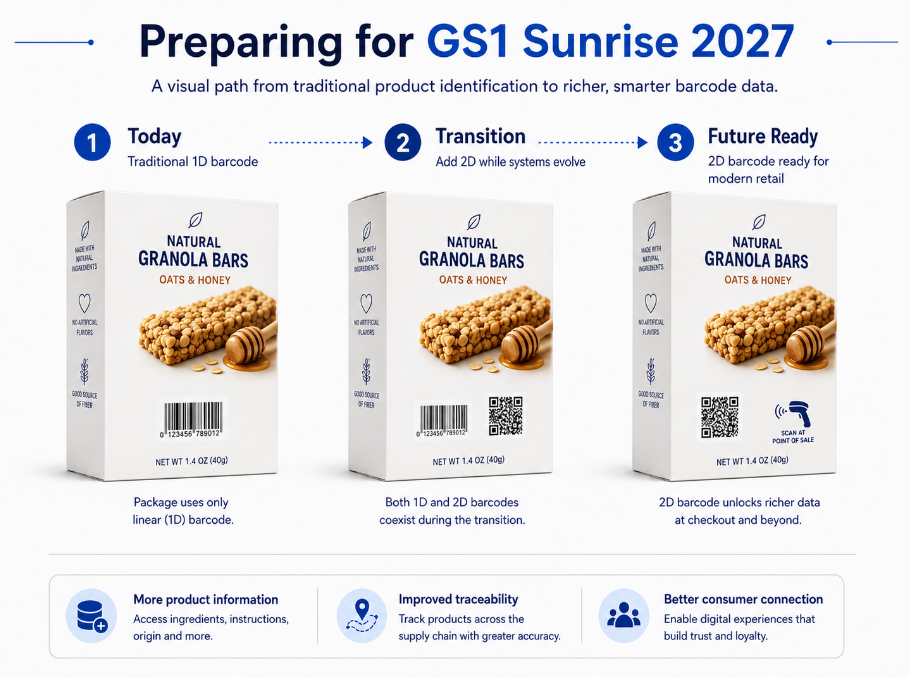















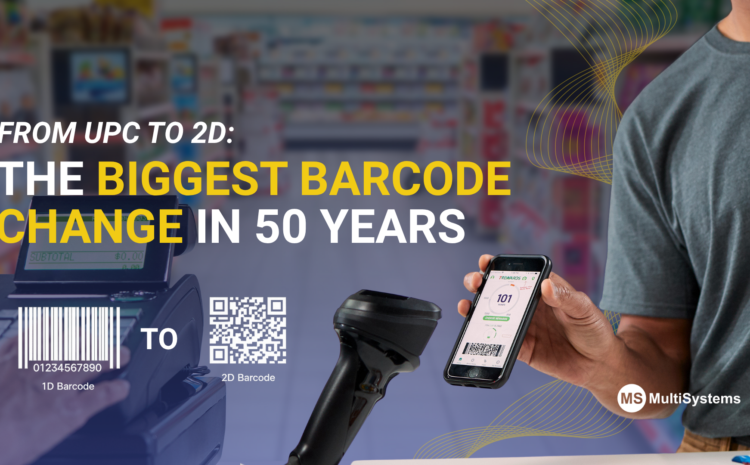
For more than 50 years, the familiar UPC barcode has helped retailers identify products, manage inventory, and process purchases. However, businesses now need to capture and share more information than a traditional one-dimensional barcode was designed to hold. Expiration dates, lot numbers, serial numbers, recall information, and digital product content are becoming increasingly important across retail and the supply chain. To support these needs, the industry is moving toward more capable two-dimensional barcodes through an initiative known as GS1 Sunrise 2027.
What Is GS1 Sunrise 2027?
GS1 Sunrise 2027 is an industry milestone aimed at making retail point-of-sale systems capable of reading and processing GS1-compliant 2D barcodes by the end of 2027. At a minimum, these systems should be able to extract the product’s Global Trade Item Number, or GTIN, from either a traditional linear barcode or a 2D barcode.
This does not mean UPC barcodes will suddenly stop working in 2027. Linear and 2D barcodes are expected to coexist during the transition, and many products may temporarily carry both formats.
The change also involves more than replacing one symbol with another. Scanners, printers, point-of-sale systems, inventory platforms, product databases, and business processes may all need to be evaluated to ensure they can correctly capture and use the new information.
Why Is the Industry Moving Toward 2D Barcodes?
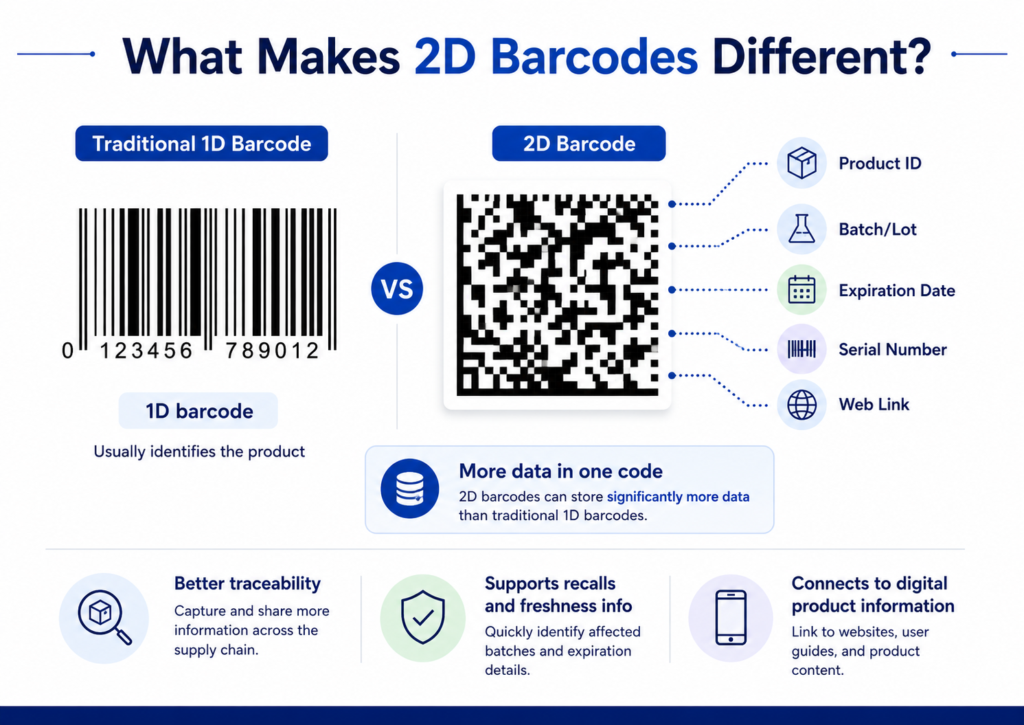
A traditional UPC barcode primarily carries a product identifier. Once scanned, the business system uses that identifier to retrieve information such as the product description and price.
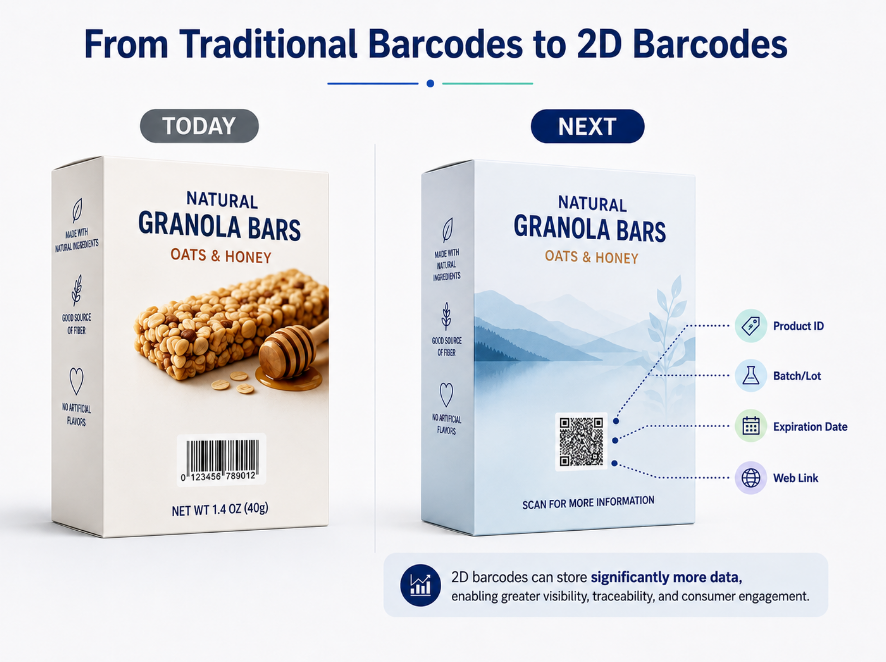
A 2D barcode can hold a larger amount of data in a compact space. Depending on the format and business application, it may include:
- GTIN or product identification
- Lot or batch number
- Serial number
- Expiration or best-by date
- Production information
- Recall and safety information
- Links to instructions, ingredients, or other online content
This additional information can support more precise product recalls, expiration-date management, inventory visibility, traceability, and consumer engagement.
For example, a retailer could use an encoded expiration date to help prevent the sale of an expired product. A manufacturer could identify the specific lot affected by a recall instead of treating every unit as affected. Consumers could also scan a code to access updated product information supplied by the brand.
Which 2D Barcode Formats Are Relevant?
Two formats businesses may encounter during the transition are QR Codes powered by GS1 and GS1 DataMatrix.
QR Codes powered by GS1
A QR Code powered by GS1 can include a standardized product identifier and connect the physical product to online information. This can allow one barcode to support product identification while also giving consumers or employees access to content such as:
- Product instructions
- Ingredient and allergen information
- Certifications
- Sustainability information
- Warranty registration
- Updated product details
Unlike a basic marketing QR code, a QR Code powered by GS1 uses GS1 standards so product identifiers and related information can be interpreted consistently by compatible systems.
GS1 DataMatrix
GS1 DataMatrix is a compact 2D barcode designed to carry standardized product information in a small area. It is already widely used in healthcare and is especially useful for applications involving serialization, lot tracking, and expiration dates.
The correct barcode will depend on the product, available packaging space, information requirements, and where the barcode will be scanned.
What Does This Mean for Businesses?
Being able to scan a QR code does not automatically make a business ready for Sunrise 2027.
A scanner might read the symbol successfully, but the software receiving the scan must also interpret the data, separate the individual elements, and send them to the correct fields. The organization must then decide what should happen after the information is captured.
For example, reading an expiration date only creates value when the system can use it to generate an alert, control a transaction, or improve inventory rotation. Readiness therefore depends on the complete process, not only the scanner.
Start With Readiness, Not Replacement
GS1 Sunrise 2027 should not be viewed as a reason to replace technology without first understanding what the business requires. The best starting point is a readiness assessment that evaluates the organization’s use cases, equipment, software, data, and workflows.
Preparing early gives businesses time to test different approaches, coordinate with their partners, and develop a phased transition plan. It also creates an opportunity to improve traceability, inventory management, recall processes, and access to product information.
MultiSystems has the experience and technical expertise to help businesses prepare for this transition. Our team can evaluate your current barcode environment, identify potential gaps, and recommend the scanners, printers, software, and integration support needed to move toward 2D barcode readiness.
Contact us to discuss your current operation and learn how we can help you prepare for GS1 Sunrise 2027.